Browse Junk removal records · Compare two itemized quotes · Method and corrections
The evidence table, explorer and exported rows share these records. Narrative examples retain their stated dates and assumptions. Coverage is limited to the listed providers and scope; no local quote or national average is implied.
Compare junk removal by volume, included labor and material type, not the phrase half a truck. Bye Junk in California lists $249 for a quarter load and $379 for a half load. Zebra Junk Removal in North DFW lists $250 for about 3.5 cubic yards and $400 for about 7.5 cubic yards, with stated labor allowances. Denver Junk Solutions lists $149 for the first two cubic yards, then $75 for each additional yard. These local menus are not a national average or equivalent offers. Sources checked October 8, 2026; amounts are USD.
Public prices with measurable scope
| Provider / location | Amount / unit | Scope / task | Checked / source |
|---|---|---|---|
| Bye JunkJunk removal | San Ramon and listed Bay Area cities, California | USD 249.00quarter load charge | Table lists 4, 7 and 15 cubic yards, but later half-load note says 7.5; ambiguity retained. Weight, access and specialty fees require written scope.Scope and limitsIncluded: Not specified Excluded / confirm: Confirm with provider Compare only the stated unit and coverage. No national average inferred. Record: junk-bye-20261008-quarter. Effective date: Not established. | Dated observation; confirm current quoteOriginal source |
| Bye JunkJunk removal | San Ramon and listed Bay Area cities, California | USD 379.00half load charge | Table lists 4, 7 and 15 cubic yards, but later half-load note says 7.5; ambiguity retained. Weight, access and specialty fees require written scope.Scope and limitsIncluded: Not specified Excluded / confirm: Confirm with provider Compare only the stated unit and coverage. No national average inferred. Record: junk-bye-20261008-half. Effective date: Not established. | Dated observation; confirm current quoteOriginal source |
| Bye JunkJunk removal | San Ramon and listed Bay Area cities, California | USD 689.00full load charge | Table lists 4, 7 and 15 cubic yards, but later half-load note says 7.5; ambiguity retained. Weight, access and specialty fees require written scope.Scope and limitsIncluded: Not specified Excluded / confirm: Confirm with provider Compare only the stated unit and coverage. No national average inferred. Record: junk-bye-20261008-full. Effective date: Not established. | Dated observation; confirm current quoteOriginal source |
| Zebra Junk RemovalJunk removal | North Dallas-Fort Worth, Texas | USD 250.00quarter load charge | About 3.5/7.5/15 cubic yards and 0.5/1/2 hours of labor. 80 USD minimum; complexity and materials affect final quote.Scope and limitsIncluded: Not specified Excluded / confirm: Confirm with provider Compare only the stated unit and coverage. No national average inferred. Record: junk-zebra-20261008-quarter. Effective date: Not established. | Dated observation; confirm current quoteOriginal source |
| Zebra Junk RemovalJunk removal | North Dallas-Fort Worth, Texas | USD 400.00half load charge | About 3.5/7.5/15 cubic yards and 0.5/1/2 hours of labor. 80 USD minimum; complexity and materials affect final quote.Scope and limitsIncluded: Not specified Excluded / confirm: Confirm with provider Compare only the stated unit and coverage. No national average inferred. Record: junk-zebra-20261008-half. Effective date: Not established. | Dated observation; confirm current quoteOriginal source |
| Zebra Junk RemovalJunk removal | North Dallas-Fort Worth, Texas | USD 700.00full load charge | About 3.5/7.5/15 cubic yards and 0.5/1/2 hours of labor. 80 USD minimum; complexity and materials affect final quote.Scope and limitsIncluded: Not specified Excluded / confirm: Confirm with provider Compare only the stated unit and coverage. No national average inferred. Record: junk-zebra-20261008-full. Effective date: Not established. | Dated observation; confirm current quoteOriginal source |
| Denver Junk SolutionsJunk removal | Listed Denver-area markets, Colorado | USD 149.00first two cubic yards load charge | Nearest half-yard increments; ordinary hauling/disposal/sweep-up included; specified access and material extras excluded.Scope and limitsIncluded: Not specified Excluded / confirm: Confirm with provider Compare only the stated unit and coverage. No national average inferred. Record: junk-denver-20261008-first_two_cubic_yards. Effective date: Not established. | Dated observation; confirm current quoteOriginal source |
| Denver Junk SolutionsJunk removal | Listed Denver-area markets, Colorado | USD 75.00additional cubic yard load charge | Nearest half-yard increments; ordinary hauling/disposal/sweep-up included; specified access and material extras excluded.Scope and limitsIncluded: Not specified Excluded / confirm: Confirm with provider Compare only the stated unit and coverage. No national average inferred. Record: junk-denver-20261008-additional_cubic_yard. Effective date: Not established. | Dated observation; confirm current quoteOriginal source |
The businesses operate in different places. A price comparison can explain their units, but it cannot tell you which one is cheaper at your address. The inconsistency in Bye Junk’s half-load volume is left visible rather than silently fixed. Ask for an item list, agreed volume or tier, and the all-in total before loading.
Half of what capacity?
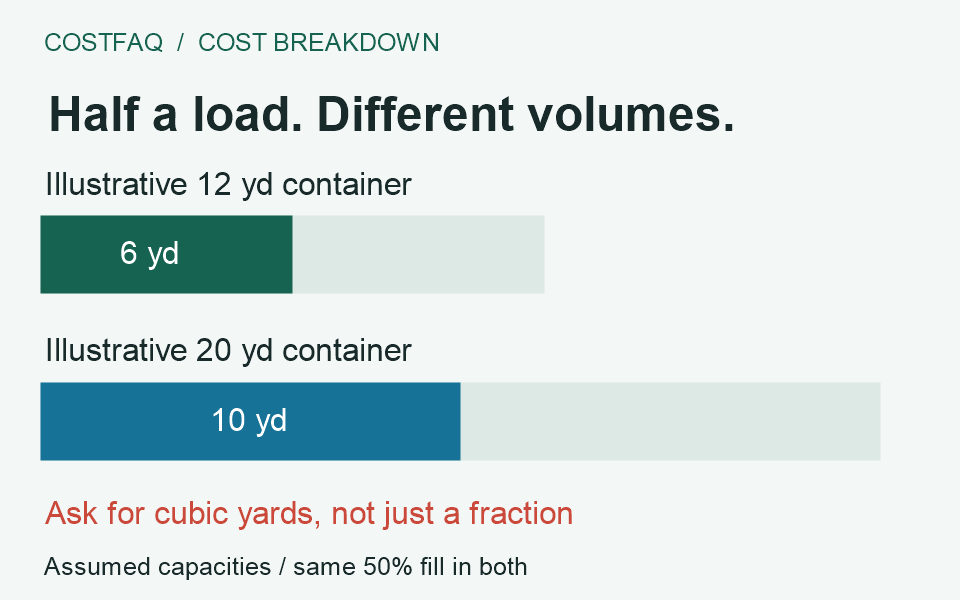
A cubic yard is 27 cubic feet: a cube three feet on each side. Half of an illustrative 12-cubic-yard container is 6 cubic yards; half of a 20-cubic-yard container is 10. The same half-load label therefore describes 67% more space in the second example. These capacities are teaching assumptions, not the dimensions of the suppliers above.
A rectangular 6 ft x 3 ft x 3 ft pile has a bounding volume of 54 cubic feet, or 2 cubic yards. Real furniture leaves gaps and may be stacked or dismantled differently, so a bounding box is not a guaranteed truck-space charge. Photos and an on-site estimate can clarify the load, but the written agreement still decides how it will be charged.
Calculate the menu, then add the actual extras
Using Denver’s published formula for an assumed ordinary 6-yard load gives $149 + (6 – 2) x $75 = $449. Eight yards give $599. This is a calculation from a menu, not a booked job. Confirm material, access, taxes and any minimum or rounding rule before treating it as a quote. Do not add the first-two-yard minimum on top of six full per-yard charges; that would count the first two yards twice.
Same pile, different labor boundary
Two hypothetical 6-yard offers are $420 with all required loading included and $350 with only 30 minutes included. If the second needs two additional half-hour blocks at an assumed $45 each, it totals $440. The apparent $70 saving becomes a $20 premium. All inputs here are illustrative; record the actual labor allowance, time increment and rate.
Dense debris is not ordinary household volume
Concrete, tile, soil and roofing material can reach a hauler’s weight limit before a container is full. Bye Junk states that a full load is limited by 2,000 lb or 15 yards, whichever comes first, and describes different loading limits for dense material. Do not price a quarter container of heavy debris as a household quarter load automatically. Obtain the material-specific quote.
Separate appliances, tires, mattresses and other special-handling items in the inventory. Bye Junk lists specific recycling and appliance charges; whether more than one fee applies to an item should be settled before pickup. Do not assume a hauler accepts hazardous materials. Ask which items are excluded and which need a separate approved disposal route.
A cleanout quote checklist
- Inventory and photos, including items hidden behind the front pile.
- Measured volume or agreed load tier and container capacity.
- Household items versus heavy or special-handling materials.
- Stairs, carry distance, parking and work from inside the property.
- Included labor, disassembly, time increments and extra trips.
- Disposal charges, tax, final sweep-up and price approval before loading.
Common pricing questions
Is a single-item price always cheaper than a load?
Not necessarily: a minimum pickup charge or item-specific fee can dominate. Request the total for your inventory instead of adding unrelated advertised offers.
Does full-service removal include demolition?
Do not assume so. Breaking down a shed, disconnecting equipment and removing building materials can be separate work. Have those tasks scoped explicitly.
Should I rent a dumpster instead?
Compare rental duration, allowed material, weight allowance and your own loading with the hauler’s labor-inclusive offer. A container rental and staffed pickup are different purchases, not interchangeable load prices.
Sources and editorial method
The linked menus support the local rates and conditions. We did not buy hauling services or copy provider photographs; the volume diagram is an original illustration with explicit assumptions. Revision note: this edition replaces the earlier broad range with provider-specific units, a minimum-charge formula, labor boundaries and an inventory checklist. Older observations remain historical rather than being redated. Editorial policy.
Continue with moving crew and travel costs, move-out cleaning scope, or the quote calculator.